Telangiectasia treatment with the copper vapor laser Yachroma-Med
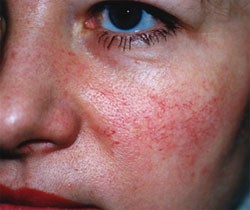
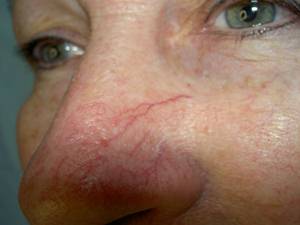
Telangiectasias localize as a rule on face and legs.
Diameters of the ectatic vessels are from 0.1 to 1 mm on the face and from
0.1 to 3 mm on the legs.
The most patients, who come to clinics of dermatology
and aesthetic surgery, are patients with telangiectasias. Telangiectasia
is term for ectatic vessels of skin, which are located on face and neck or
on legs, in about of 60% and 20% of cases respectively.
About 30 % of fare skin population suffer from the
telangiectasias.The most common factor in occurrence of facial
telangiectasia is weakness of the vessel walls due to chronic sun
exposure. Genetic predisposition, liver disease, surgical trauma,
radiation therapy, chronic steroid use, deep chemical peeling of the face
may also play a role.
Methods of removing
telangiectasias may be selective and non selective. Some years ago a common
method was electrocautery. Electrode may equally destroy ectatic vessel and
adjacent normal tissue. Thus scars, hipo- and hiper- pigmentation may occur
after electrocautery.Most physicians consider that
non-selective methods are not suitable for the vascular and pigmented skin
lesions removing in case of facial location.
Selective laser coagulation is based on the concepts of
selective photothermolysis. Abnormal vessels selectively absorb laser light
and warmed. The vessel temperature increases to 60 – 70 Celsius degrees causing the
abnormal vessels destruction. Adjacent tissue far less absorbs light of
“vascular” laser and don’t injuring. Thus light of “vascular” laser
may selectively destroy of abnormal tissue. The treatment is accurate as in
microsurgery. Radiance of “vascular” laser must have the characteristics
to provide the selective destruction of telangiectasias.
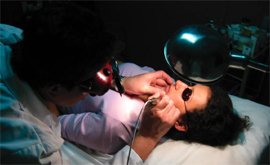
Adult patients tolerate the treatment of
telangiectasias with the copper vapor laser “Yahroma-Med” without
anesthesia. Local anesthesia can be required for the most sensible
patient. The treatment with other “vascular” laser available on the
market is more painful. The patients suffer no pain after the procedure.
Middle erythema can occur during two hours after the
treatment. After the copper vapor laser treatment scabs can be noted along
treatment vessels can be noted. They spontaneously resolve during 3 to 7 days.
However many physicians using Yahroma-Med choose such laser parameter that
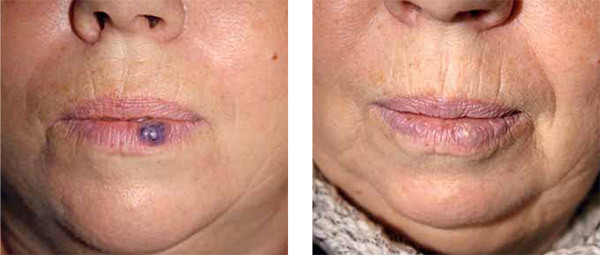
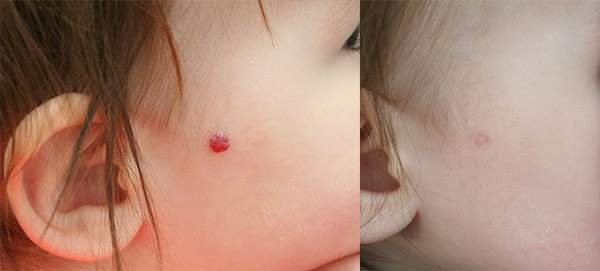
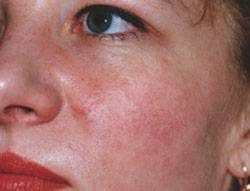
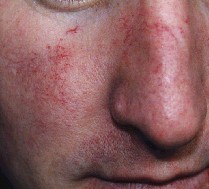
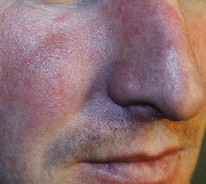
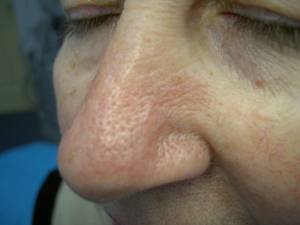
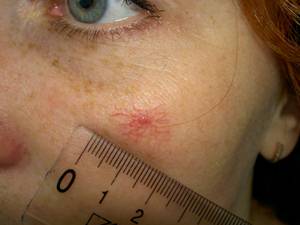
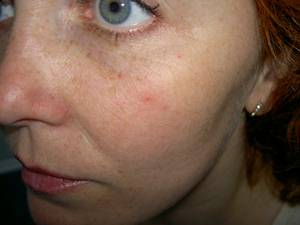
scabs can’t be noted at all. On photos 1 and 2 you can see the patients
before and a day after one treatment session with Yahroma-Med.
Complete or almost complete clearance achieved in 90% of patients.
Telangiectasias on cheeks are usually easy to treat. Telangiectasias of
nasal alae are more complicated for treatment and required particular
caution. Some patients with telangiectasias of nasal alae may be resistant
to the treatment (about 4%).
Abnormal vessels disappear during the treatment. Most abnormal vessels
disappeared after one treatment but not all vessels. Appearance of the
patients notably improved (photo 1 and 2). Many patients satisfied by the
results of one treatment. However two or tree treatments may be require
for removing all ectatic vessels.
New ectatic vessels can began to appear in some years if the patient
predisposed to telangiectasia. In the beginning they may be easy removed
by laser. If the patient avoid the factor, which play a role in occurrence
of telangiectasias, ectatic vessels may not appear at all.
To prevent another onset of rosacea you should continue to protect your face with creams offering high protection against infrared, UVA and UVB rays, and refrain from using sunlamps.
It is advisable to create a barrier against atmospheric agents in the city by using good moisturizing creams and suitable cosmetic products. In fact, when the wind, cold and smog attack the skin they are potential vasodilators. Be careful with your diet too: certain foods (like alcohol, chocolate, salami, and fried or spicy foods) cause inflammation and vasodilatation.